Storage Vault
Inside the vault frame
The highest-value zone in the institution. Every entry logged at device level, cross-referenced against deaccession waivers and TMS movement records.
Deaccession correlation · TMS feed
Fine art crime is the third-largest illicit market in the world after drugs and arms. The Gardner heist still hasn't been solved 35 years later. Insurance carriers no longer underwrite uninsured-quality security at any premium. Digital Tripwire produces device-level proximity records on every gallery wall, every storage vault, every loading dock, and every loan transfer event, with the chain of custody required by AAM accreditation, AXA Art coverage, and the FBI Art Crime Team.
Museums, galleries, and auction houses operate on infrastructure built for an art market that no longer exists. The original assumption was that the threat came from the outside: smash-and-grab heists, after-hours forced entry, masked burglars. The modern reality is that the dominant fine art crime pattern is internal — a registrar, a curator, a conservator, an art handler, or a long-trusted contractor who walks an authenticated piece off the back dock during a perfectly normal week.
Cameras might catch a silhouette in the gallery. They cannot identify the person who was holding a deaccession waiver in the vault during the moment a piece moved from "on view" to "in storage" to "missing." Insurance carriers increasingly refuse to underwrite institutions that cannot produce defensible chain of custody. The FBI Art Crime Team and Interpol's stolen art database close cases on forensic evidence, not on grainy footage.

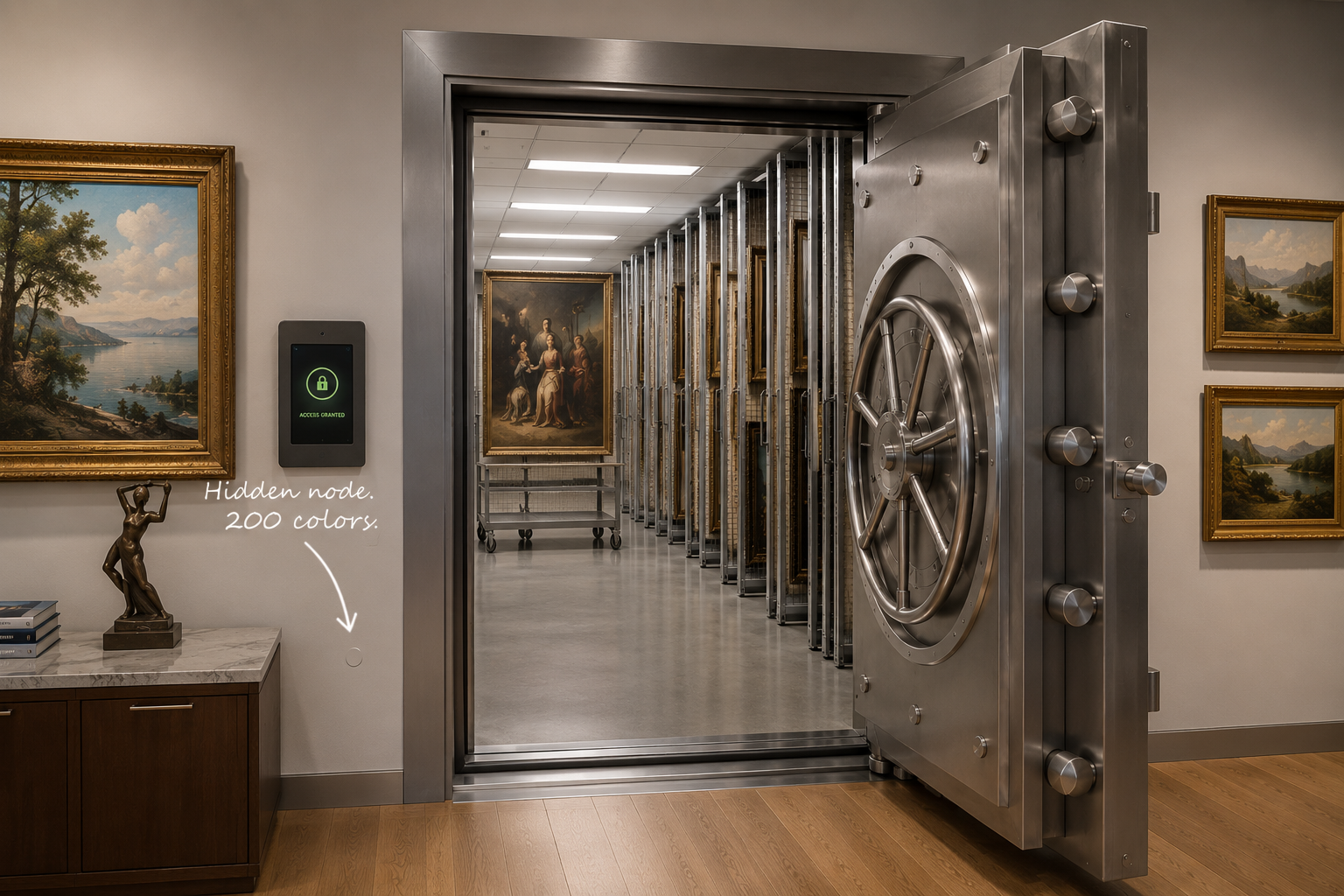

Digital Tripwire deploys at the high-value zones across museum, gallery, and auction house operations: gallery thresholds and walls, secure storage vaults, conservation labs, registration and shipping rooms, loading docks, evening-sale floors, and vault transfer corridors. The deployment scales from a single private gallery to a national auction house network with peak-event coverage on evening-sale weekends.
When a node detects motion or proximity, it scans every Bluetooth and Wi-Fi device within 10 feet. MAC address, signal strength, distance, timestamp. Uploaded over LTE-M cellular, independent of facility network or collection management system. The log cross-references against TMS, Argus, NetX, and FileMaker records, against loan-out and loan-in events, and against deaccession waivers. The piece that moved from gallery to vault at 4:08am has a device cluster attached.
Strategic node placement covers the high-value zones across museums, galleries, and auction houses. Designed for AAM-accredited institutions, AXA Art-underwritten collections, and major auction house evening-sale operations. Tap a node to see what it protects — or run the demo and watch a 4:08am collection movement get logged.
Inside the vault frame
The highest-value zone in the institution. Every entry logged at device level, cross-referenced against deaccession waivers and TMS movement records.
Deaccession correlation · TMS feed
Inside the door frame
Public exhibition flow and after-hours. The moment a piece stops being "on view" is the moment that matters.
On-view state change · after-hours
Inside the dock frame
Loan transfer and shipper handoffs. The back dock is where an authenticated piece walks off during a perfectly normal week.
Loan transfer · shipper handoff
Inside the frame
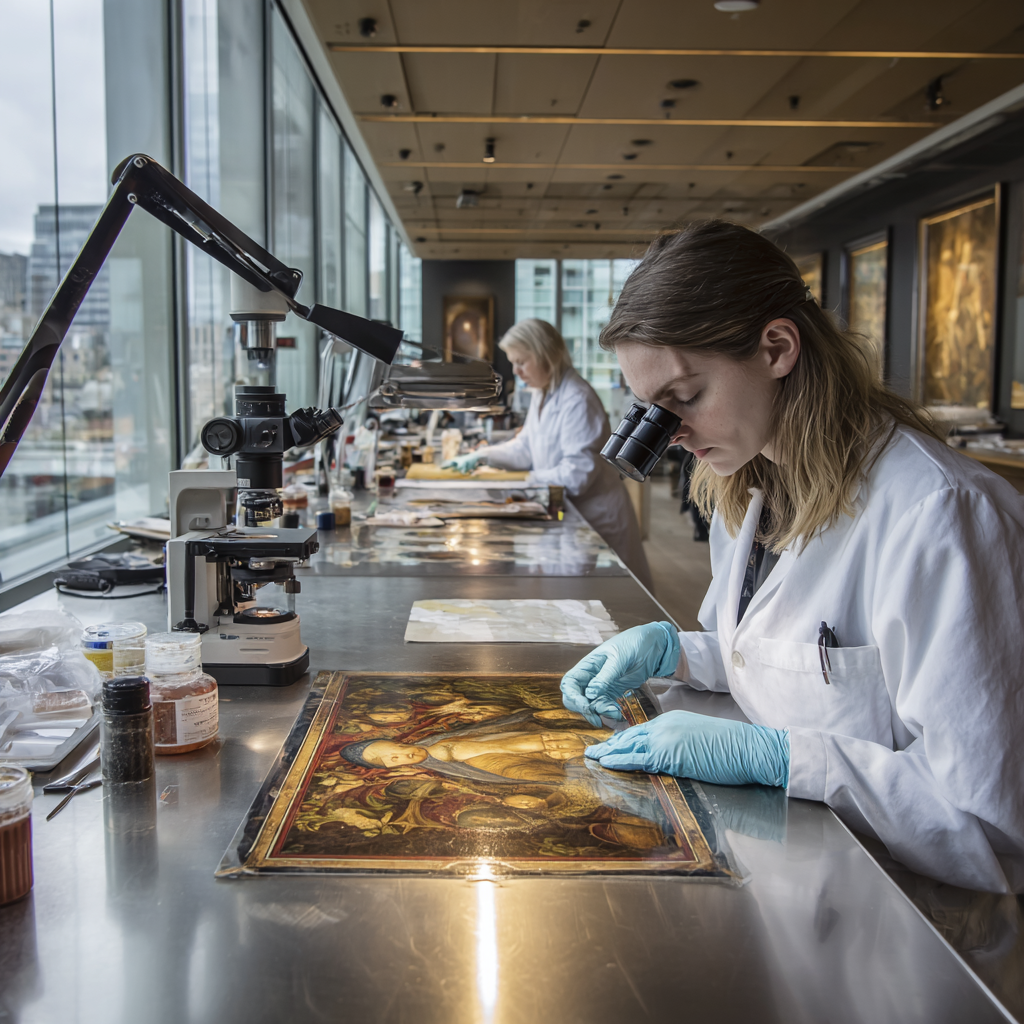
Treatment and examination chain of custody. Pieces leave the gallery legitimately and sit here for months.
Treatment custody · conservator log
Inside the frame
Accession, deaccession, and loan documentation. Where the paperwork that authorizes a movement gets signed.
Waiver correlation · accession record
Wall mount
Movement between vault, lab, and shipping. Every collection movement crosses this corridor, whether it is on the record or not.
Movement chain · transit log
Mounted to the fixture
Evening-sale peak inventory. Hundreds of millions concentrate here for a finite, advertised window.
Per-lot logging · peak-event window
Inside the frame
Pre-event signal touchpoint. The crate opener, the hanging hardware, the handling tools all live here.
Tool access · pre-event signal
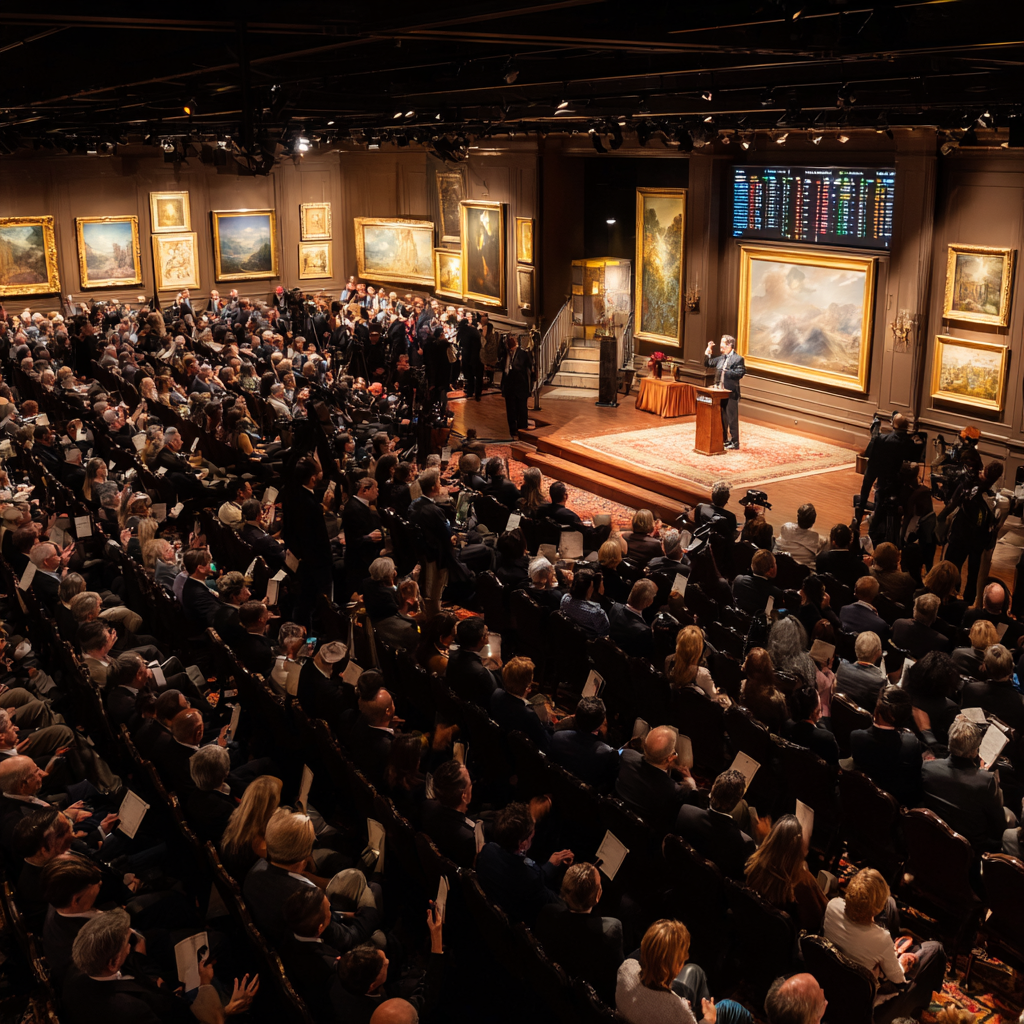
Auction houses operate under a fundamentally different exposure profile than museums. Christie's, Sotheby's, Phillips, Bonhams, and Heritage all manage extreme peak inventory windows: the night of an evening sale, the days before during preview, the immediate post-sale collection period. Hundreds of millions of dollars in inventory concentrate at a single physical location for a finite, predictable, advertised window.
The standard security stack — cameras, badge access, security personnel — is engineered for steady-state operations. It does not move when the exposure does. Digital Tripwire deploys temporary high-density nodes for evening-sale weeks on top of permanent vault infrastructure, with per-lot proximity logging for the highest-value works during the sale window.
The fine art insurance market has shifted decisively in the past five years. AXA Art, Chubb Fine Art, AIG Private Client, Berkley One, and the major Lloyd's specialty syndicates have systematically tightened underwriting requirements. Documented physical security is no longer a discount factor — it is increasingly a coverage prerequisite. An institution that cannot produce defensible chain of custody faces premium increases of 25-50% at renewal, coverage exclusions on traveling exhibitions, and in some cases outright non-renewal.
The underwriting question has evolved from "do you have cameras" to "can you produce a forensic record of who was actually present at the moment of every collection movement."
The fine art world operates under a stack of professional, regulatory, and recovery frameworks. AAM accreditation requires documented physical security and collection management protocols. AAMD provides ethical and operational guidelines. ICOM defines global standards for collection care. The FBI Art Crime Team and Interpol's stolen art database coordinate recovery. The Art Loss Register provides commercial provenance verification. A security vendor that does not understand the provenance and recovery infrastructure is a vendor that fails the first AAM accreditation review.
Digital Tripwire is engineered against the full institutional stack. The proximity log integrates with TMS, Argus, NetX, and FileMaker as an audit-ready feed. Loan-out and loan-in events are documented with hash-signed records that satisfy lender contract requirements. Deaccession waivers cross-reference against actual movement records. Recovery network integration produces evidentiary packages the FBI Art Crime Team and Interpol can act on directly.

We asked former FBI forensics investigators, federal prosecutors, and family court judges. They'd never seen BLE proximity data used as evidence. Until now.


AAM accreditation requires documented physical security, collection management protocols, and chain of custody on collection movement. Digital Tripwire produces hash-signed proximity logs that satisfy the documentation standards AAM accreditation reviewers look for, particularly for the Collections Stewardship and Facilities and Risk Management standards. The proximity log integrates with existing TMS, Argus, and NetX collection management platforms as a supplemental audit feed, not as a replacement, and is documented as an additional control layer during the next accreditation review cycle.
Fine art insurance carriers — AXA Art, Chubb Fine Art, AIG Private Client, Berkley One, Lloyd's specialty syndicates — increasingly require documented physical security as a coverage prerequisite, not just a discount factor. Institutions with hash-signed chain-of-custody records on collection movements typically negotiate 5-15% premium reductions on permanent collection policies, broader coverage on traveling exhibitions, and in some cases coverage on works that were previously uninsurable. The deployment is documented as a control infrastructure addition during the next renewal cycle, with the carrier's risk engineering team supporting the evaluation.
Traveling exhibitions are the highest-risk fine art operation in the museum world. Each loan transfer involves multiple chain-of-custody touchpoints: condition report, crating, loading, shipping, receiving institution unloading, condition recheck, installation. Digital Tripwire produces hash-signed proximity logs at every fixed touchpoint within the lending and receiving institutions, and portable per-crate nodes can be deployed for the transit window itself. The full forensic record produces lender-contract chain of custody that satisfies AAM, lender insurance carriers, and recipient institutional risk management at the same time.
The system captures MAC address proximity, signal strength, and timestamps in a fully-monitored, badge-controlled cultural institution where staff already operate under documented monitoring frameworks established by AAM accreditation, lender contracts, and underwriter requirements. Public exhibition spaces are already monitored by camera systems that visitors are aware of through standard signage. The data does not capture identity, content, or personal information, and the proximity log has practical investigative value only when correlated with a security event or collection movement.
Auction house deployments are designed for the unique peak-event exposure profile of evening sales. Permanent infrastructure covers the vault, warehouse, registration, and conservation areas year-round. Temporary high-density node deployment supplements the permanent infrastructure during preview, sale, and collection windows. Per-lot proximity logging is available for the highest-value works during the sale event window. Coverage includes Christie's, Sotheby's, Phillips, Bonhams, Heritage, and regional auction houses with comparable peak-event profiles.
Multi-site institutional deployments are designed for full-network rollouts, which is where cross-site pattern matching compounds. Each site gets a hub and a node kit sized to the facility footprint and risk classification. Hubs auto-provision over LTE-M on first power-up. No site-level IT involvement required. Most pilots are 1-2 sites for 90-180 days with cross-site pattern matching enabled, then a phased rollout across the network. International deployments are supported through regional cellular IoT and regional cloud infrastructure aligned with local frameworks such as the UK Government Indemnity Scheme and EU export controls.
Institutional pricing scaled to collection value and site count. Pilot a single institution in 90-180 days. AAM accreditation alignment, AXA Art and Chubb Fine Art audit-ready export, FBI Art Crime Team coordination, auction-house evening-sale peak-event coverage.
Request a Collection Briefing