Senior Living Abuse & Neglect Documentation

When the victim
can't tell you
who or when.

Roughly one in ten Americans over 60 experiences elder abuse each year. Less than one in twenty-four cases ever gets reported. The evidentiary record is almost always thin: a bruise the family noticed, a confused report from a resident with dementia, a complaint from a CNA who's afraid to be named. Digital Tripwire produces a forensic chain of custody on who was actually present and when. Not a verdict. A record that an investigation can build on.

1 in 10
Americans over 60 experience abuse each year
1 in 24
Cases of elder abuse that get reported
30 day
Typical surveillance retention — gone before investigation
0
Systems that identify who was at the resident's door
Before we pitch anything else

"Of course I was there. I work there."

A CNA who works the 3-11 shift on Memory Care B will appear in the proximity log of Memory Care B every single shift. That is not evidence of abuse. That is evidence of doing the job. Any system that pretends otherwise is selling something it cannot deliver, and any plaintiffs' attorney or APS investigator who relies on raw proximity records to prove anything will lose the case.

Digital Tripwire does not solve elder abuse. It does not identify perpetrators on its own. It does not prove anything by itself. What it does is corroborate or contradict the human accounts that an investigation is built on. A confused 87-year-old says her son-in-law hurt her on Thursday at dinnertime. The proximity log either places him there or it does not. A CNA gets accused by a resident with dementia. The proximity log either supports the accusation or it clears the falsely accused. The system produces a record. The record is one piece of evidence among many. That is what makes it valuable.

The Underreported Reality

The most vulnerable.
The least able to speak.

Adult abuse and neglect in long-term care settings is structurally underreported in a way no other category of abuse is. The resident may have dementia and be unable to give a coherent account. The resident may be afraid of retaliation from the staff who feed and bathe them. The resident may be physically unable to use a phone. The resident may not have language to describe what happened. The CNA who saw something may be afraid to be named because they need the job. The family member who notices a bruise gets told it was a fall. By the time anyone investigates, the resident has been moved, the staff has rotated, the surveillance footage has been overwritten on the 30-day cycle, and the evidentiary record is whatever everyone thinks they remember about a Thursday three months ago.

The result is that elder abuse cases that should win lose, and elder abuse that occurred goes undocumented. Wrongful death suits settle for nothing because the plaintiff cannot meet the burden of proof. Adult Protective Services investigations close as unsubstantiated. State licensure surveyors find paperwork violations and miss the underlying conduct. Families spend the rest of their lives wondering. The structural problem is not that people do not care. The structural problem is that the evidence is gone before anyone can examine it.

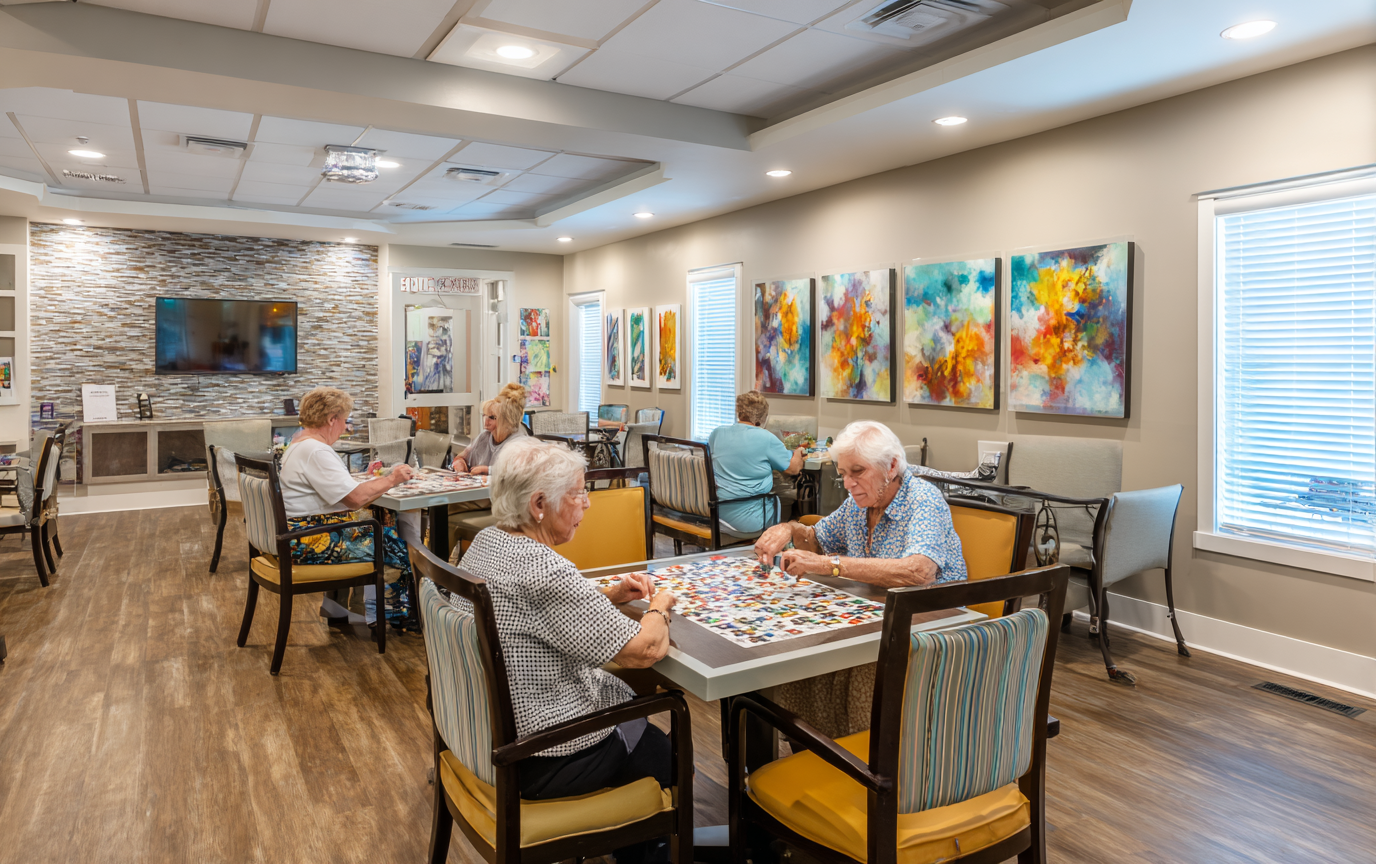
Senior living recreation room
Where the Nodes Go · Interactive

8 thresholds that cover
the facility without entering the resident's room.

The proximity infrastructure sits at doorways, corridors, medication storage, common areas, and back-of-house staff zones. It does not sit inside the resident's private living space. The 8 thresholds below are the recommended starting deployment for a typical senior living building. Tap one to see what it captures, or run the demo and watch a family visitor's arrival reconstruct into the kind of record an APS investigator can build a Thursday-at-5pm question on.

nodes sleep until touched · or tap one
BACK-OF-HOUSE · LOADING KITCHEN · LAUNDRY · STAFF MEMORY CARE A DEMENTIA CARE · HIGH SCRUTINY RESIDENT ROOMS MEMORY CARE B DEMENTIA CARE · HIGH SCRUTINY COMMON AREA · DINING PUBLIC ZONES · ACTIVITIES NURSING STATION STAFF COORDINATION MED CABINET DEA SCH II ASSISTED LIVING · RESIDENT ROOMS ASSISTED LIVING · RESIDENT ROOMS INDEPENDENT LIVING · RESIDENT ROOMS VESTIBULE · MAIN ENTRY RECEPTION · SIGN-IN
Live threshold log● LIVE
✓ Visitor path corroborated @ 17:14 · Vestibule → Nursing → Memory Care A → Resident Threshold · 4A:31:0E:88:2C:F7 · hash-signed
S1

Vestibule · Main Entry

Reception, family sign-in, primary entry

The main entry is where family visits, contractors, delivery drivers, and staff shift changes all pass through. Threshold logging here corroborates or contradicts the visitor sign-in sheet, which historically is the only record of who was in the building on any given day.

Highest priority · magenta zone

S2

Nursing Station

Staff coordination point

The nursing station is the operational hub of the wing. Threshold logging captures shift-change movement, medication runs, and family handoffs. Not evidence of anything by itself. Corroborative context for anything the shift log or care plan is used to establish.

Interior · staff coordination

S3

Memory Care A

Dementia care wing · higher scrutiny

Memory care is where the highest-vulnerability residents live and where structural underreporting of abuse concentrates. Threshold logging at the wing entry captures every device transition into and out of the unit, including staff, family, contractors, and unauthorized presence.

Restricted zone · higher scrutiny

S4

Memory Care B

Second dementia care wing

Symmetric to Memory Care A. Together the two wing entries cover the concentration of dementia-care residents. Cross-wing proximity events (a staff member appearing in the log of a wing they are not assigned to) are the exact pattern the record surfaces that no other system does.

Restricted zone · higher scrutiny

S5

Medication Cabinet

DEA Schedule II storage · controlled substances

The medication cabinet holds controlled substances subject to DEA Schedule II handling requirements. Threshold logging here corroborates the medication administration record and surfaces after-hours access patterns that a paper log cannot.

Restricted · DEA Schedule II

S6

Resident Room Threshold

Outside the door, not inside

The node sits at the corridor side of the resident's doorframe. It captures which devices crossed the threshold and when. It does not capture what happened inside the room. Resident dignity is preserved by the system's architecture, not by promise.

Threshold only · not inside room

S7

Common Area · Dining

Public zones, activities, dining

The common areas are the highest-traffic public zones in the facility. Threshold logging here places specific devices at specific times during meal windows, activity programming, and general public presence. Corroborative context for what a resident, family member, or CNA remembers about a specific afternoon.

Public zones · corroborative context

S8

Back-of-House · Loading

Kitchen, laundry, staff-only service areas

The service side of the facility handles deliveries, kitchen operations, laundry, and staff-only zones. Threshold logging here separates authorized service traffic from after-hours breaches that used the same door, and corroborates contractor accountability records.

Service · contractor accountability

How the Record Actually Helps

Three ways it changes
an investigation.

None of these scenarios use the proximity record as proof of abuse. All of them use the record to corroborate or contradict the human accounts that the case actually rests on. That is the entire mechanism.

1
Corroboration of the Specific Time

She said Thursday at 5pm.
He said he wasn't there.

A confused 87-year-old resident with mid-stage dementia tells her daughter that her son-in-law was at her unit on Thursday around dinnertime and that he hurt her. The son-in-law tells the family he was at work all week and never visited. The family is conflicted and the facility's incident log shows nothing. Adult Protective Services declines to open a case because the resident's account is the only evidence and she is not a reliable historian.

RECORDThe son-in-law's device cluster at the resident's unit threshold Thursday at 17:14 for 22 minutes. The record does not prove abuse. It proves he was lying about being there.

2
Pattern Across Multiple Incidents

Three concerning events.
One common variable.

A facility documents three separate concerning events involving the same resident over six weeks. A bruise on the arm March 8th, attributed to a fall. A confused report of being hit on March 22nd, dismissed as a memory artifact. A bathroom fall with unusual injuries on April 5th, classified as routine. Each event taken individually looks like the kind of thing that happens in memory care. The facility's risk manager closes each one as unsubstantiated.

RECORDOne CNA's device cluster appears at the resident's unit during all three windows, including two of the dates when the schedule assigned them to a different wing. The record does not name a perpetrator. It identifies a pattern that justifies an investigation that otherwise would not have happened.

3
Exclusion of the Wrongly Accused

She said it was Maria.
Maria was on the other floor.

A CNA gets accused of abuse by a resident with dementia who is genuinely confused about who hurt her. The accusation triggers an immediate suspension under facility policy, an APS notification, a state survey investigation, and a media inquiry. The CNA, who has a clean record, is now facing the loss of her job and her certification over an incident she had nothing to do with. The resident is sincere and the facility cannot ignore the report, but the record of the resident's actual care that day is the staff schedule and her own confused memory.

RECORDThe accused CNA was on a different floor during the entire window of the alleged incident. The record does not prove no abuse occurred. It proves this CNA was not the person involved, and redirects the investigation to whoever was actually present.

One record. Different audiences.
The proximity log is one piece of evidence among many. It corroborates or contradicts the account. It does not decide the case.
Resident Dignity and Capacity

Watches the threshold.
Not the resident.

Senior resident reading in a bright private living space

The proximity infrastructure does not exist inside the resident's room. It exists at the doorway, the corridor, the medication storage cabinet, the public common areas, and the back-of-house staff zones. The dignity of the resident's private space is preserved. There are no cameras, no microphones, no recording devices in the bathroom, in the bed, or anywhere a resident has a reasonable expectation of privacy. What the system records is which devices crossed which thresholds at which times.

The capacity question is real. A resident with advanced dementia cannot meaningfully consent to monitoring. The deployment framework for senior living is therefore scoped through the resident's responsible party (a family member with healthcare power of attorney, a court-appointed guardian, or the resident themselves where capacity allows), with explicit involvement of the facility's resident advocate, the state long-term care ombudsman, and where appropriate the resident's family. The framework is conservative by design. The system is meant to protect the resident, not to add another layer of surveillance to a population already over-monitored in the wrong ways and under-protected in the right ones.

  • No recording infrastructure inside resident rooms or bathrooms
  • Threshold and corridor proximity only
  • Deployment scoped through resident's responsible party
  • State long-term care ombudsman involvement available
  • Records released only on legitimate investigation request
Who Uses the Record

One record.
Different audiences.

The same proximity log serves a family member trying to understand what happened to their parent, a facility operator trying to defend against a wrongful claim, an APS investigator trying to substantiate a case, a plaintiffs' attorney building wrongful death litigation, and a defense attorney representing a falsely accused staff member. None of those readers wants the same thing from the record. All of them want the record to be honest.

Family Member

Adult Children of Residents

The daughter who lives 1,200 miles from her mother's facility and is worried about something that doesn't add up. The proximity log answers the question of who was actually with her mother during the period that concerns her, available through the facility's standard family records access process.

Facility Operator

Risk Manager / Administrator

The administrator who needs to defend the facility against a claim, document compliance during a state survey, or surface a problematic staff pattern before it becomes a wrongful death suit. The proximity log provides the chain of custody record that surveillance footage alone cannot.

APS Investigator

Adult Protective Services

The county or state APS investigator working a case that opened on a thin allegation. The proximity log provides one more independent data point that either substantiates the report or contradicts it. The standard for substantiation does not change. The available evidence does.

Plaintiffs' Bar

Wrongful Death & Abuse Litigation

The plaintiffs' attorney representing a family in wrongful death or abuse litigation. The proximity log is one piece of evidence among many in a case that also includes medical records, depositions, prior complaints, and the resident's own account. It strengthens cases that should win.

Defense

Falsely Accused Staff

The CNA whose certification is on the line for an incident they had nothing to do with. The proximity log clears the wrongly accused, which is itself a form of evidentiary value the existing infrastructure does not produce.

Insurance

Senior Living Carriers

Specialty senior living insurance carriers recognize documented physical security and chain of custody as an underwriting factor. The deployment supports premium reduction at renewal under existing carrier control evaluation processes.

Expert Validation

What actually holds up
in court?

We asked former FBI forensics investigators, federal prosecutors, and family court judges. They'd never seen BLE proximity data used as evidence. Until now.

Nizar Balil

Nizar Balil

Former FBI & Interpol Digital Forensics Investigator. 20+ years in digital evidence analysis and courtroom testimony.
VERIFIED EXPERT
Lisa Pyle

Lisa Pyle

Former NYC Criminal Prosecutor & Federal Ethics Attorney
VERIFIED EXPERT
Marquis Jones

Marquis Jones

Former Family Court Judge & Deputy Attorney General
VERIFIED EXPERT
What Digital Tripwire Is Not

Honest about
the limits.

Every claim on the rest of this page rests on the integrity of these limits. A system that pretends to do these things is a system that will fail the resident, the family, and the case.

×

Not a replacement for cameras in common areas

Surveillance footage is still the primary visual record. Digital Tripwire supplements it with device-level identification, not replaces it.

×

Not a fall detection system

Life Alert, Lively, and other personal emergency response systems detect falls and summon help. Digital Tripwire does neither. The systems serve different purposes.

×

Not a perpetrator identification system

Proximity records identify devices, not people. Connecting a device to a person requires the standard investigative methods: badge correlation, ownership records, witness testimony.

×

Not a substitute for human judgment

An APS investigator, a plaintiffs' attorney, a state surveyor, and a facility risk manager all bring judgment the technology cannot replace. The record supports their work, not the other way around.

×

Not inside resident rooms

No recording infrastructure inside the resident's private living space. Threshold and corridor proximity only. Resident dignity is preserved by design, not by promise.

×

Not a verdict

A proximity log is one piece of evidence among many. Cases close on the totality of the evidence. The record makes weak cases stronger and false cases harder. It does not decide the case.

Regulatory and Insurance Alignment

Built for the regulators
in this space.

Senior living operates under an interlocking framework of state assisted living regulators, CMS for skilled nursing certification, state Adult Protective Services agencies, the long-term care ombudsman program in every state, state boards of nursing for staff licensure, the DEA for Schedule II opioid handling at skilled nursing facilities, and HIPAA for protected health information. Senior living insurance carriers underwrite abuse, neglect, wrongful death, and elder financial exploitation as the dominant loss categories.

Digital Tripwire is engineered to operate within this framework, not adjacent to it. Proximity records are not protected health information and do not fall under HIPAA. Records are released only on legitimate investigation request through the facility's records access policy, the resident's responsible party, an APS subpoena, a state survey request, or court order. Insurance carriers in the senior living specialty recognize the deployment as a documented control during renewal underwriting.

State Assisted Living CMS / Skilled Nursing Adult Protective Services Long-Term Care Ombudsman State Boards of Nursing DEA Schedule II HIPAA-Aware Senior Living Insurance
Senior living activity room with regulatory documentation context
CAPTURE
eventproximity-detect
device4A:31:0E:88
thresholdmemory-care-a
time17:14:22Z
sha256: b872…5d19
CELLULAR UPLOAD
pathLTE-M
facility netbypassed
time17:14:23Z
prev: b872…5d19
sha256: 3e14…a802
RECORDS ACCESS REQUEST
viaresponsible party
scopespecific window
ombudsmannotified
prev: 3e14…a802
sha256: c9a4…71ef
EXPORT
formatCSV / JSON
APS / surveysubpoena-ready
integrity✓ intact
chain of custody: complete
Device identifiers only — not PHI, not clinical data
Hash-signed at capture, independently verifiable
Released only on legitimate investigation request
Recognized by senior living carriers as underwriting control
Family and Operator FAQ

Common questions.

Directly. A CNA who works the 3-11 shift on Memory Care B will appear in the proximity log of Memory Care B every shift. That is not evidence of abuse and we do not represent it as such. The proximity log creates value in three specific ways: it corroborates or contradicts a specific account of a specific incident at a specific time, it surfaces patterns across multiple incidents that the existing record-keeping cannot, and it clears falsely accused staff. None of those uses depends on the proximity record alone proving anything. They depend on the proximity record being one piece of independent evidence in a case that includes medical records, witness statements, surveillance footage, staffing schedules, and the resident's own account. The objection is correct. The system is designed around it.

No recording infrastructure exists inside the resident's room or bathroom. Proximity nodes are placed at corridor thresholds, common areas, medication storage zones, and back-of-house staff areas. The system records which devices crossed which thresholds at which times. It does not record what the resident did, what the resident said, or what happened inside the resident's private living space. The dignity of the private space is preserved by the system architecture, not by promise. Deployment scoping involves the facility's resident advocate, the state long-term care ombudsman where appropriate, and the resident's responsible party for residents who lack capacity to consent independently.

Proximity records are not protected health information under HIPAA. The records identify device hardware identifiers and timestamps, not clinical or medical information. The system does not capture, store, or transmit any clinical record, medication record, or treatment information. Because the data is not PHI, it does not fall under HIPAA's Business Associate framework in the same way an EHR or pharmacy system would. The deployment is reviewed alongside the facility's privacy officer and legal counsel to confirm scope.

Records access is governed by the facility's standard family records policy, the resident's responsible party authorization, and the resident's own consent where capacity allows. Most facilities provide proximity records access in the same workflow they already use for other facility records (visitor logs, medication administration records, care plans). The proximity record is a facility business record subject to the same disclosure framework that governs the rest of the resident's care record.

APS investigators and state surveyors can request proximity records through standard subpoena and survey authority. Records are exportable in CSV and JSON formats with hash-signed chain of custody documentation. The records support but do not replace standard investigation methodology. APS substantiation standards, state survey deficiency findings, and licensure outcomes continue to be determined by the relevant agency on the totality of the evidence.

Senior living insurance carriers underwrite abuse, neglect, and wrongful death claims as a dominant share of the loss profile. Documented physical security and chain of custody affect underwriting evaluation at renewal under existing carrier control assessment processes. Specific premium impact depends on policy size, loss history, and carrier risk engineering review. The deployment is documented as a control infrastructure addition during the next renewal cycle.

Independent living residents have full capacity to consent to monitoring and the deployment framework treats them as the primary decision-makers about whether the system is active in their unit. Assisted living residents typically retain capacity but operate under a more involved care framework. Memory care residents often lack capacity to consent independently and the deployment framework relies on the resident's responsible party with explicit involvement of the resident advocate and the state long-term care ombudsman. The technical deployment is identical across these populations. The consent and oversight framework varies appropriately.

Facility pilots are typically scoped to a single building or wing for 90–180 days, with formal review by the facility risk manager, the medical director, the resident advocate, the state long-term care ombudsman where appropriate, and a representative of the resident family council. Pilot evaluation criteria are established in advance and include incident response time, false-positive rate, family records access workflow, and compatibility with existing surveillance and badge access infrastructure. Contact us for facility-specific pilot scoping.

Request a Briefing

A record
an investigation can build on.

Briefings available for facility operators, family members, Adult Protective Services, plaintiffs' counsel, defense counsel for staff, state long-term care ombudsmen, and senior living insurance carriers. We work within the existing legal, regulatory, and ethical framework that already governs this population.